Description Wild: If you’ve ever felt weakness, that your goal is too…
Description
Wild:
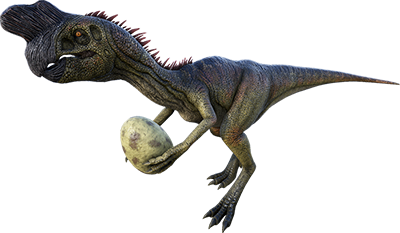
If you’ve ever felt weakness, that your goal is too hard to complete or that you can’t fend for yourself, then meet Oviraptor Philodator, because they feel you, as Oviraptor Philodator knows well not to take risks, and not without reason.
Oviraptor Philodator is much like us when we first start out our days on these very same ARKs; scattered, clueless, hungry, and just barely defenseless. These go as follows:
-Defenseless; Oviraptor Philodator possesses claws that are far too short to act as any real sort of weaponry, instead used to pick up its own eggs for moving them out of harms way, and its beak is just barely lethal to humans, despite only using it against them in the rare case they are curious enough to scoop up its unattended egg.
-Diet; Oviraptor Philodator is lucky it even has the abilities that it has, to be fair; preferring the eggs of other creatures over regular meat despite being a carnivore, and the only reason this is allowed to fly is due to a pheromone it uses to calm the creatures it has stolen eggs from, as well as to encourage quicker laying of future eggs. Were it not for this, Oviraptor Philodator would run the risk of being attacked on-sight. Oviraptor Philodator will only hunt insects if desparately hungry, similar to Quetzalcoatlus Conchapicem.
-Body and Appearance; Oviraptor Philodator already knows well to stay away from strange-looking creatures, as once a predator comes to realize it to be small and fearful, it will swiftly attempt to dispatch the Oviraptor in question. However, it is also incredibly afraid of humans, likely due to their larger size, lack of scaly exterior or beak, and their ability to fight. Considering the sheer fragility of Oviraptor Philodator, one can hardly blame its caution.
Domesticated
The standards for domesticating Oviraptor Philodator are rather strange compared to other creatures, in the sense that it will only eat eggs for the duration of this time period, however, how much progress in trust-building is random, yet dependent on the species the egg came from, as well as how long the Oviraptor in question has been around for (determined by the “leveling” system).
In particular, individuals of Oviraptor Philodator that have been around for longer will have been used to the wilderness for longer, and will need extra time to re-acclimate, regardless of the rarity of the egg in question (with rarer eggs tending to be tastier and therefore yield even more trust).
For this reason, a common approach used by many is to apply a soothing solution, like a Balm of some kind. This calms the Oviraptor in question down by letting it know that you are a friend, not a foe. Paired with the desired eggs and the Oviraptor Philodator in question will soon come to realize that you can be trusted.
It will also become brave enough to fight, having now-realized that it can survive dangerous encounters, and eat raw meat by extension. However, tamed Oviraptor Philodator tend to fall into 2 categories; either a breeding assist, or a housepet, especially if it proves to be the more typical, feable Oviraptor.
So therefore while the bravery of tamed specimens of Oviraptor Philodator is certainly appreciated, its not really necessary, is it? Whatever the reason, survivors will always find a reason to tame it, even if just because they want a rather odd-looking housepet.
More Oviraptor Utility Tips
Everyone needs to know and it is dev confirmed that Oviraptors DO NOT buff chances of mutations or twins or triplets. This is a long going myth that needs to be shut down. Any twins or triplets you are getting is purely coincidence. This was said by one of the devs on twitter!
These guys can steal eggs without aggroing surrounding dinos! You can get easy wyvern and rock drake eggs! Put it in a cryo pod, sneak into a nest, pop it out of the pod and have it set to follow close, run to the other side of the nest and when it gets to the nest it will take the egg. Once it has the egg you can take the egg from it and there won't be any aggro. Just make sure you don't switch the egg out of your inventory because you'll get the aggro then. Rinse and repeat for super easy wyvern and rock drake eggs!
Egg-stealing dinosaur was innocent,
THE rare discovery of a fossil embryo has cleared the name of a dinosaur
called “egg stealer”. Oviraptor, first discovered apparently making a meal of
another dinosaur’s eggs, was, it now turns out, simply trying to hatch its own
offspring.
In 1923, an expedition from the American Museum of Natural History in New
York found the first Oviraptor skeleton on a nest of eggs in the Mongolian
desert. The scientists thought the elongated eggs belonged to Protoceratops, a
plant-eating dinosaur whose fossils were common in the area. They chose the
name Oviraptor because they assumed the animal, a predator with sharp claws
and a parrot-like beak, was trying to eat the eggs when it was caught in a
sandstorm and died.
No one could confirm that a Protoceratops had definitely laid the eggs,
however. The contents of fossil eggs are hardly ever preserved. But in the
latest issue of the journal Science, a team of researchers from Mongolia and
the American Museum report on their discovery of a very similar egg containing
a tiny Oviraptor skeleton, almost ready to hatch. The egg was found 300
kilometres from the site of the 1923 excavations.
The 80-million-year-old embryo is the first found from the group of
dinosaurs related most closely to birds. Like birds, dinosaurs brooded their
young, says Mark Norell of the American Museum.
Advertisement
The same nest contained another curious find – the skulls of two tiny young
carnivores belonging to the same family as the velociraptors, best known as
the terrors of Jurassic Park. It is possible that these small carnivores were
raiding the nest. However, Norell says the absence of any other bones suggests
the skulls “were brought to the nest by adult [oviraptors] who had cleaned out
a Velociraptor nest” and like modern ospreys, brought their catch home to
eat